


There’s been a lot of talk about generative AI in speculative fiction land lately. A lot of people are angry, a lot of people are worried, and a worrying number of people are all in on the Plagiarism and Pollution Machine. But within all that, sometimes it can feel like the joy is slipping away. So let’s take a few minutes to enjoy some art, shall we? These are ten great stories from ten great short speculative fiction publications that I read in June, and I’m so excited to share them with you all.
“As Per My Last Email” by Eleanor Rasor
(Luna Station Quarterly — June 2026; issue 66) I’ve said it many times before, but I’m a sucker for a creative and unusual narrative structure. Rasor writes this story through a series of electronic communications. Some are automated emails sent to two competing academics, Raisa and Kirill, regarding their library checkouts, some are emails between them, and the rest are texts between them and their friends. An enemies-to-lovers fantasy romance gradually unfolds, and I am nothing if not also a sucker for a well done romance trope.
“The Best Part” by Ann Chow
(Uncharted — June 2026) Written from the perspective of a húli jīng, a nine-tailed fox spirit from Chinese folklore, Chow’s story feels like a slice of something bigger, like it’s part of a larger world Chow is exploring elsewhere. Our fox spirit sets her sights on a man named Xú Yuánlǎng, so much so that she’s can’t stop obsessing over him. Her fantasy of him becomes grander than the reality, and her sister’s warnings to keep her distance fall haunt her.
“Grave Bells” by Corey Farrenkopf
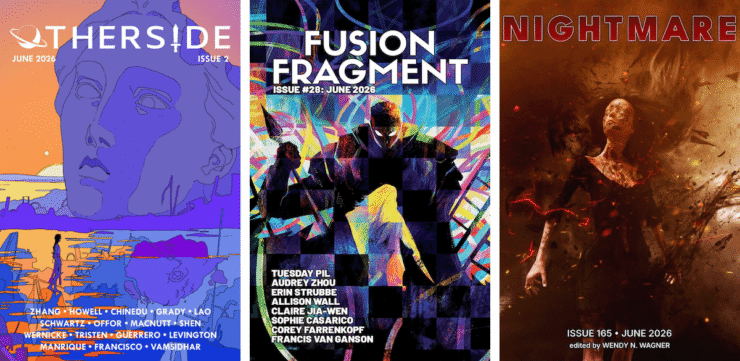
(Fusion Fragment — June 2026; issue 28) In an eco-dystopian near-future, the polluted ocean has her revenge with this clever take on the zombie apocalypse. When the waters rise with the tides, they infect human corpses. Ruth is training her son Julien on digging graves. They tie bells onto a corpse’s fingers so the living hear it if they rise. Julien hates the work, but if they don’t do it no one will. Like all great eco-horror, the plans Ruth makes about her and her son’s future fall apart, and Farrenkopf does a stellar job leading us to the inevitable conclusion.
“The Keyhole” by Natalia Theodoridou
(Strange Horizons — June 14, 2026; Fund Drive 2026) An unnamed man hides in his apartment. He has isolated himself from the world, accepting groceries and books by contactless delivery and unable to even watch TV. So it’s startling when not only does he discover he can see into the room of an unknown girl in an unknown house through the keyhole in his bedroom door but that he also wants to connect with her. The girl is not alone. Who is watching her, the man cannot see, but what if someone is watching him too? What if he isn’t as alone as he thought? What if somewhere out there someone is yearning to connect with him? It’s a beautiful, terrifying thought.
“Only in the Dark” by Elizabeth Winfield
(PseudoPod — June 19, 2026; 1034) This was a wild, unsettling piece. It’s structured as several episodes of a children’s puppet show featuring two humanoid characters, Toast and Bagel. They live in a room in a dystopian world. With each episode, more of the room and world deteriorate, and the monsters lurking in the shadows get closer. The line Toast says at the end of every episode takes on new and frightening meanings each time, “And remember, only in the dark do the brightest stars shine!”
“Pythia” by Juniper White
(Flash Point Science Fiction — June 2026; issue 3) “I wonder if you’ve seen this letter in your dreams. Did you foretell this, too, my darling? Do you know what I’ll write even as my pen jitters, uncertain, in my hand?” A lovely bit of flash fiction about knowing the world is awful and striving anyway to make things better, about putting yourself on the line in the hopes that your children or your grandchildren won’t have to. It made me think of that quote from Andor: “I burn my life to make a sunrise that I know I’ll never see.”
“Somewhere Among Fallen Leaves by Plangdi Neple
(Trollbreath Magazine — June 2026; issue 8) This was such a beautiful exploration of queerness, homophobia, going no contact, immigration, and generational trauma. Our protagonist is a Nigerian living in Canada with his white husband, James. Their soon-to-be-adopted daughter Aisha is sick in the hospital and our protagonist thinks he knows why. Using magic, he returns to the home he left years ago and to the mother he hasn’t spoken to since she rejected him. They must work together to break a curse placed on her that has spread to him and his new daughter.
“We Who Were Raised by Tigers” by P. V. Vamsidhar
(OTHERSIDE — June 2026; issue 2) “In your last life, you were a tiger princess…In this life you are a man named Peril, and the age of tiger princesses has been squeezed along by history’s fat intestine for a very long time now.” Like the previous story by Neple, Vamsidhar looks at queerness through a unique lens. We see snapshots of the life of the tiger princess who disregards her more feminine sister as being a silly nothing and of Peril’s modern, corporate, boring life. As the two lives intertwine when Peril gets an implant that reveals to him his previous life, he takes his first steps toward discovering his truth. Not every coming out journey is the same.
“What Grows Back” by Aishatu Ado
(Nightmare — June 2026; issue 166) “I have told this story before, and I will tell it again, and each telling grows more teeth. Sometimes thirty-four, thirty-six. Sometimes they multiply faster than your science allows, like every word you made me swallow coming back to bite you.” TEETH. teethteethteethteethteeth. Apparently I still have Widow’s Bay on my mind, because I couldn’t turn this story away. I don’t want to tell you too much about this one—part of the thrill is watching the way it twists and turns on itself, revealing and hiding new facets with every segment. It is a fairy tale and a nightmare.
“You Have Arrived at Your Destination” by Jo Miles
(Escape Pod — June 25, 2026; 1051) As a certified hater of self-driving vehicles (I live in SoCal where they are a plague on our roadways), I was hesitant when I came across this story. But it’s Jo Miles and I usually enjoy their work, so I gave it a chance. Pleased to report that it’s lovely. Emily has a self-driving car that gains a mind of its own. Instead of taking her to her set destinations, it takes her to new experiences and places she might not have tried on her own. Instead of technology narrowing her world down to her phone and a mode of transportation, it becomes a bridge to a wider world. That’s how computers and the internet used to feel like, in the Before Times.